
Conditions
If you’re nearsighted, you can see clearly up close but likely find it difficult to read street signs or see far away objects in detail. Nearsightedness (myopia) is the most common cause of poor vision, affecting more than 40% of the U.S. population. Diagnosing nearsightedness is done through an eye exam at our Indianapolis practice.
Nearsightedness can be corrected with glasses and contacts, but many patients come to Price Vision Group for surgical options such as Implantable Contact Lenses (ICL), LASIK, PRK, and refractive lens exchange to correct their nearsightedness and avoid the daily hassle and large yearly expenses of contacts. A large study with 1,800 patients comparing satisfaction and long-term risk rates for eye infections and ulcer have shown patients are generally safer and happier after LASIK than daily contact lens wear.1
If you are nearsighted and would like to explore your options for visual freedom, request a FREE screening or call us at 317-814-2933 to schedule an appointment, otherwise, keep reading below for more detail about this condition.

What is Nearsightedness?
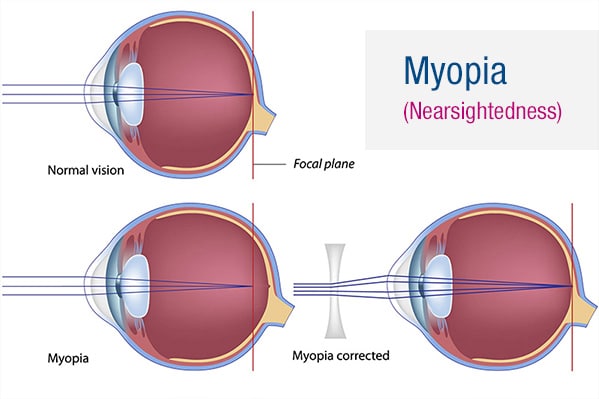
In order to see clearly, light entering the front of the eye through the cornea must be focused on a single point on the retina at the back of the eyeball. These light rays are bent (refracted) by the cornea, and further bent and focused by the lens of the eye, ideally reaching the target zone on the retina. Nearsightedness is a refractive error which causes the light to focus at a point in front of the retina, rather than on it. This makes objects at a distance appear out of focus.
What Causes Nearsightedness?
Nearsightedness can be caused by an eyeball that is too long, or by a cornea that is too sharply curved, or a combination of both. This prohibits the light from reaching the retina, making distance vision blurry. Although heredity is the primary cause of myopia, eye fatigue from up-close tasks like reading and using a computer may contribute to the condition.
Treatment
How Can Nearsightedness Be Treated?
With the right prescription, glasses or contact lenses correct the refractive error, adjusting the trajectory of light so that it focuses directly on the retina. Unfortunately, many people find glasses impractical or cumbersome, and they find contacts to be uncomfortable, drying or prohibitively expensive on an annual basis.1,2 For patients unable to tolerate contact lenses, Evo ICL is a great option that we offer for consistent visual freedom, with LASIK, PRK, and refractive lens exchange being other alternatives to consider.
Testimonials
LASIK & EVO ICL Patient Testimonials
Katie Stam Irk
Morgan M.
Katie S.
Tracy H.
Refractive Surgery
Refractive Surgery for Nearsightedness Correction
LASIK, PRK, and other refractive surgeries often produce results that are better than 20/20, and liberate patients from the discomfort, expense, and hassle of corrective lenses.
At Price Vision Group, we feature three internationally renowned corneal specialists, who are also authorities in the field of LASIK and other ophthalmic surgeries. Our surgeons travel the world to teach their techniques to their peers, and our reputation draws patients from across the country.

References
- Price MO, Price DA, Bucci FA, Durrie DS, Bond WI, Price FW. Three-Year Longitudinal Survey Comparing Visual Satisfaction with LASIK and Contact Lenses. Ophthalmology. 2016;123:1659-66.
- Markoulli M, Kolanu S. Contact lens wear and dry eyes: challenges and solutions. Clinical Optometry. 2017;9:41.